
EcoRestoration Alliance · v10h · 2026
Cooling Climate Quickly
A New Perspective Reveals New Options
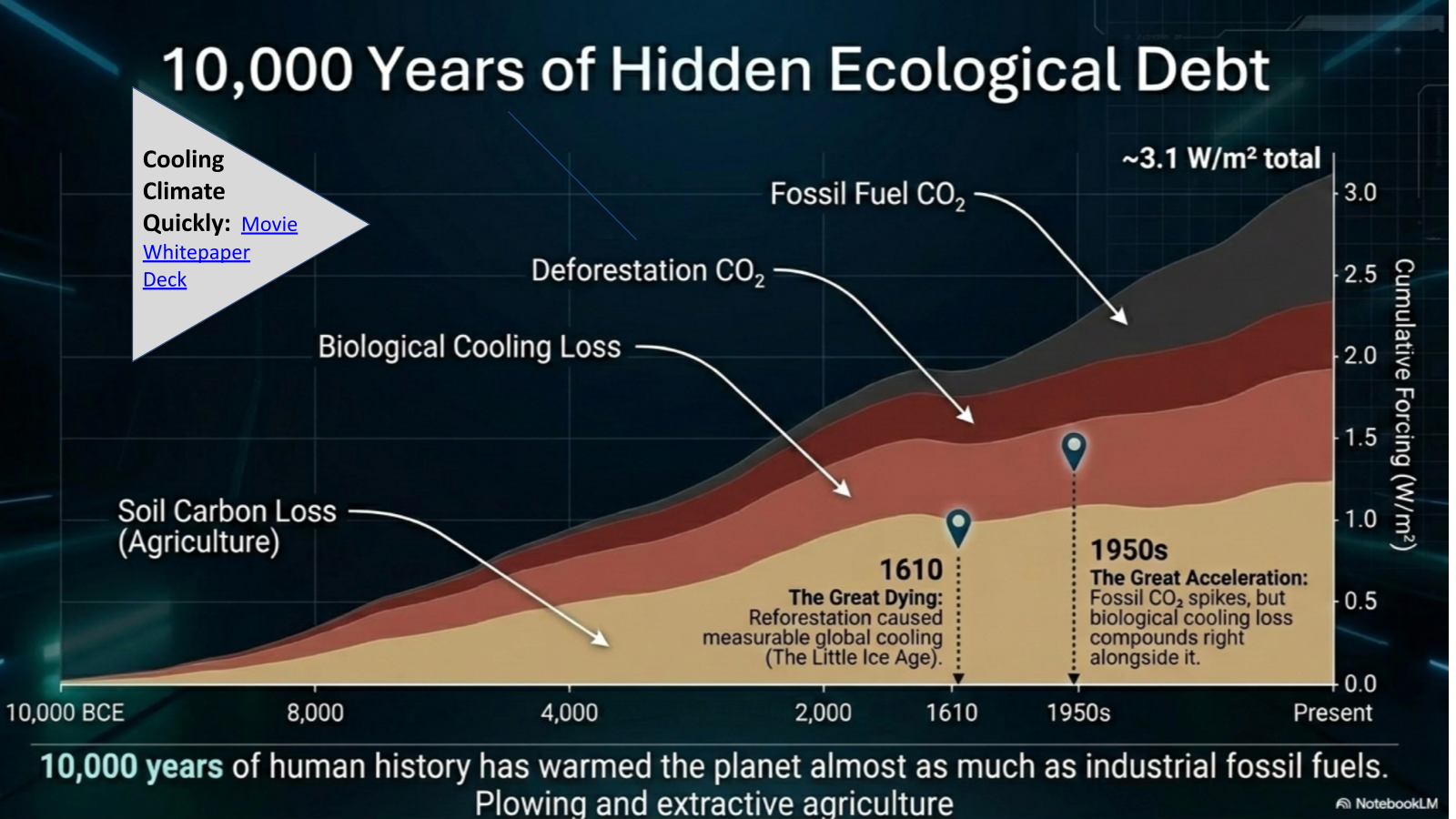
Ten thousand years of human history has warmed the planet almost as much as industrial fossil fuels. The same biological cooling we dismantled can be restored — rapidly and powerfully by driving water cycles, slowly but surely by sequestering carbon.
Cooling Climate Quickly — three ways in
Companion piece: The Making of Cooling Climate Quickly
What This Paper Argues
We are losing the climate battle because our primary analytical tool — carbon accounting — blinds us to the fastest solutions available. Living ecosystems cool the planet through mechanisms largely invisible to carbon frameworks, and these mechanisms are being destroyed.
In January 2020, a shipping regulation accidentally ran a planetary experiment: cutting ship-fuel sulfur by 80% dimmed the clouds those ships had been seeding for a century. Ocean temperatures visibly warmed within months — not decades. The effect was two to four times larger than models predicted. The implication is stark: cloud formation, evapotranspiration, and biological aerosol production are fast-acting climate levers that carbon accounting simply cannot see.
Forests are the largest source of cloud-seeding aerosols over land. When forests are cleared, the same dimming mechanism fires — without anyone measuring it, funding it, or counting it. Marine phytoplankton play the same role over the ocean. Every hectare of degraded ecosystem is a missed lever.
Ecosystem degradation accounts for an estimated 23–38% of total anthropogenic forcing — comparable to fossil fuels at the upper end, and up to roughly 53% if an ocean contribution still under evaluation is confirmed — and includes the only components that can be rapidly reversed. Biophysical cooling from ecosystem restoration is 2–4× carbon sequestration on the critical 10–20 year timescale, with restored ground cover delivering 2–4°C of local surface cooling within months.
These interventions produce livability — food security, water security, breathable air — as an inseparable co-product. They are not "co-benefits." They are the primary outputs of a living planet.
The paper introduces two concepts that reframe what "effective climate action" means: lability — how fast an intervention produces measurable cooling — and human-adjacency — how directly it benefits the communities who implement it. When you score interventions on lability and human-adjacency alongside magnitude, ecosystem restoration rises to the top. It is precisely the interventions invisible to carbon accounting, and therefore unfunded, that score highest.
Key Findings at a Glance
Biophysical cooling from ecosystem restoration is 2–4× carbon sequestration on the 10–20 year timescale.
Ecosystem degradation accounts for an estimated 23–38% of total climate forcing — comparable to fossil fuels at the upper end (up to ~53% if the ocean term is confirmed).
Restored ground cover cools the surface within months; a full cool dome of this magnitude builds over one to two decades.
Watts per square metre measures all climate mechanisms on equal terms — carbon and non-carbon alike.
How ERA Members Can Participate
ERA's network spans scientists, practitioners, and allied organizations worldwide. The paper is designed to be tested, amplified, and extended by that network. Three ways to engage:
Review the paper's claims, cite supporting work, challenge weak assumptions, and help locate peer-reviewed data that strengthens or qualifies the analysis. The paper welcomes rigorous critique as much as support.
Offer a scientific review →Write a short "buttress post" applying the paper's framework to your area — a specific ecosystem, region, or intervention type. Ground-level evidence from practitioners is what transforms a synthesis into a movement.
Propose a buttress post →Forward the paper to peer organizations, place it in front of scientists and policymakers in your network, and help it reach the audiences who can test and act on its recommendations.
ERA Members area →