The Living Earth Handbook:
A Narrative Guide
"Therefore Choose Life: An Urgent Call to Action"
Visuals and narration by Gemini 2.5 Pro and Nano Banana
Assembled by Claude Opus
Orchestrated by Jon Schull as part of his
continuing effort to align artificial, natural, and human intelligences for the greater good.
Welcome, students, to the most urgent course of our time.
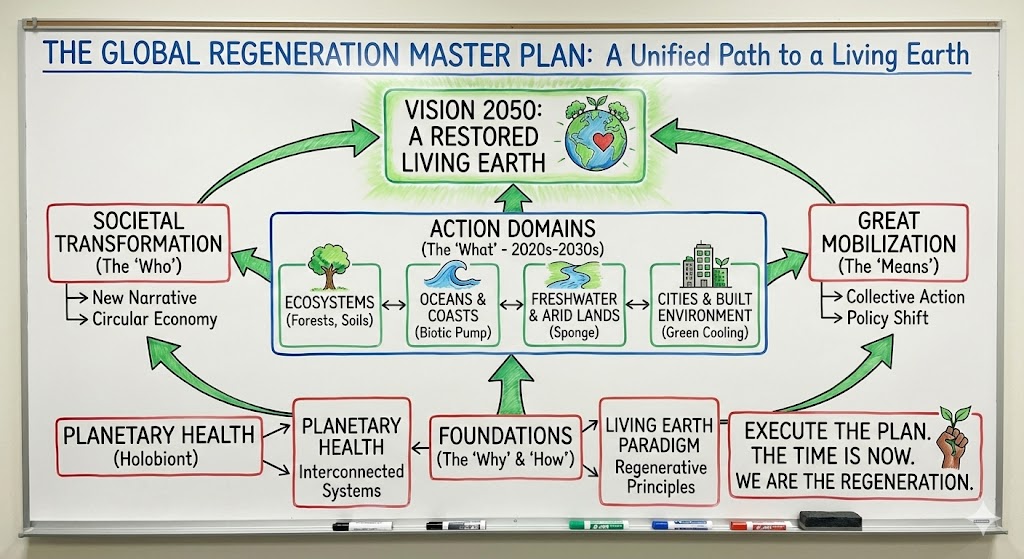
We are moving beyond the diagnosis of climate change and into the cure: Ecosystem Regeneration. This handbook is designed to be studied in two parts: read the big picture narrative here on the left, and examine the corresponding detailed whiteboard diagrams on the right. Let's begin.
1. The Core Paradigm: It's Not Just Carbon, It's Life
The Great Cooling Pump
For too long, we have had "carbon tunnel vision." We focused on the gas and forgot the engine. The Earth's climate is primarily regulated by its living systems—forests, wetlands, and microbiomes—which act as a massive Biotic Pump. They move water, generate clouds, and vent heat into space. As the diagram on the right shows, when we destroy living infrastructure, this pump fails, and the planet overheats. The shift we must make is from a "physics-only" view to a "living systems" view. Our goal is to restore the Earth's natural cooling capacity.
2. The Specialized Domains: Healing the Organs of Gaia
Just like a body, the Earth has vital organs that need specific care. We must apply regenerative principles across four key domains.
- The Oceans (The Heat Sink): Oceans & Coastlines
The ocean is our primary heat sink, absorbing over 90% of excess planetary heat. It is not an inert pool; it's a dynamic, living system. Coastal ecosystems like mangroves and kelp forests are critical for locking away carbon and buffering coastlines. We must protect 30% of our oceans and end destructive fishing practices to allow marine life to rebound and perform its cooling function. - The Atmosphere (The Sky): Atmosphere & Climate
We can't just engineer the sky; we must heal it. Forests release volatile organic compounds (VOCs) that act as seeds for clouds. These clouds reflect sunlight and are essential for the water cycle. By restoring forests, we naturally restore the atmospheric biotic pump, a far safer and more scalable solution than risky geoengineering. - The Land & Freshwater (The Sponge): Freshwater & Arid Lands
On continents, water is life. Our modern practices of draining wetlands, damming rivers, and exposed industrial agriculture have desiccated the land. We must reverse this by rewetting continents—removing obsolete dams, reintroducing beavers, and using agriculture that builds a "soil carbon sponge" to hold water. A rehydrated landscape is a cool landscape. - Our Cities (The Green Coolers): Urban & Built Environments
Our concrete jungles are "heat islands." But they don't have to be. We can transform them into engines of regeneration by integrating nature. Green roofs, urban forests, and permeable "sponge city" pavements can lower temperatures, clean the air, and improve our quality of life.
3. The Human Connection: We Are The System
- Planetary Health is Human Health: Planetary Health & the Holobiont
We are not separate from nature. We are a "holobiont"—a host organism dependent on a vast microbiome, just like the soil. As we poison the soil with chemicals, we poison our own gut microbiomes. Restoring the Earth's ecosystems is the most effective public health strategy we have. - The Societal Shift: From Extraction to Regeneration
We must transition from a linear "extraction-to-collapse" economy to a circular "regenerative" one. This isn't just about recycling; it's about designing our energy, food, and economic systems to build resilience and thrive with nature, not just survive extraction.
4. Action & Vision: The Great Mobilization
- Your Personal Role: Engaging for Impact
Where do you start? Right where you are. Rewild your yard, support local regenerative food systems, and educate your community. These small actions, when multiplied, create the foundation for systemic change. - Breaking the Gridlock: The Great Mobilization
We face massive inertia from old-world interests. Overcoming this requires collective action. We must organize, divest from destruction, and advocate for policies that incentivize regeneration. We need a "Great Mobilization" of effort across all sectors of society. - The Vision: A Restored Living Earth
Keep your eye on the prize. We are not just trying to avoid disaster; we are building a future where humanity thrives within a restored, vibrant biosphere. A future of healthy ecosystems, stable climates, and regenerative societies.
This is the work of our lifetime. Class is dismissed. Now, go out and regenerate.